

Four Fletcher students participate in selective NXT Fellowship


Last month, students in the Master of Arts in Law and Diplomacy (MALD) degree program and Master of International Business (MIB) degree program traveled to India to participate in the NXT Fellowship, a selective eight-day immersion program in New Delhi.
According to the NXT program, 70 fellows travelled to India from 39 universities across the world, including Harvard University, Stanford University, University of Cambridge, University of Oxford, London School of Economics, Tsinghua University, Johns Hopkins University, Tufts University – The Fletcher School, National University of Singapore, University of Tokyo, as well as leading institutions across India such as Indian Institute of Technology Madras, Indian Institute of Science Bangalore and IIT Gandhinagar. From Armenia and Bhutan to the United States, Europe, and East Asia, the cohort reflects the truly global spirit of the program.
Over the course of the fellowship, fellows networked with key economic and policy stakeholders, traveled around the country to learn from local communities, and conducted a research project, which they presented at the program’s conclusion.
Launched by the NXT Foundation and hosted by Indian media conglomerate iTV Network, the fellowship took place during the NXT Conclave. Dean of Global Business Bhaskar Chakravorti attended and spoke at two events, delivering a keynote on artificial intelligence (AI) and its social impact and participating in a fireside chat on the future of hard and soft technologies.
“The idea of the conclave is to understand how we are at the frontiers of a variety of different transformations that are happening globally, ranging from space to medicine, AI, military technologies, and geopolitics,” he said in an interview with The Fletcher School.
“It covers the subjects that we care about at Fletcher, but also looks at them specifically from an India angle,” he added. “The fellowship was an opportunity for the students to participate in a series of events that were much larger than the conclave.”
Chakravorti put out a call for students to apply to the fellowship, and four students were selected.
“India is becoming a key player at the intersection of global affairs, technology, and business,” Chakravorti said. “Whether you end up working in India or connected with an Indian organization, these connections are going to be enormously helpful over the course of anybody's career.”
In a conversation with Fletcher, the four student fellows reflected upon their experience.
Preparation for a Diplomat
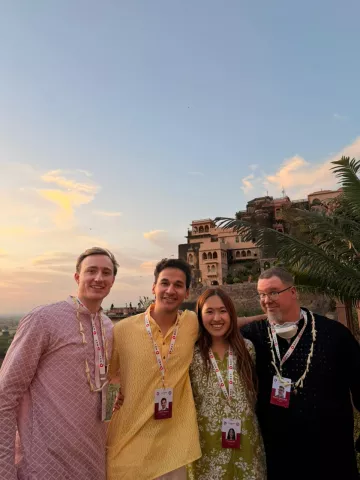
The NXT Fellowship in India is a fully-funded experience that brings together young leaders around the world to discuss some of the most pressing challenges facing our world, while learning about India, the Indian growth story, and India's role in rising to meet some of these great challenges. Though the fellowship is in many ways built around the NXT Conclave in Delhi, which featured Prime Minister Narendra Modi as a chief guest, it is also its own track and offered fellows the opportunity to explore gems of India including the Neemrana Fort Palace and the Taj Mahal, take part in morning yoga, and engage top policymakers and thought leaders in masterclass sessions.
As a MALD student focusing on international security and Russian and Eurasian affairs—and as a Pickering Fellow heading to work at the United States Embassy in Helsinki, Finland this summer—a trip to India was the perfect, unexpected yet relevant break in my semester. Themes of AI, Indian border security, diplomatic engagement with Central Asia, and India's unique relationships with Russia, China, and the U.S. are all highly applicable to what I focus on at Fletcher and what I may encounter during my upcoming summer internship in Helsinki.
-Ryland Pitts, F26
India’s Response to AI Boosterism
The very first lecture was delivered by Dr. K. V. Subramanian, former chief economic advisor to the Indian government and International Monetary Fund executive director for India. It was not a highly technical lecture, but as the speaker walked us through his analysis of what India would need to accomplish in order to grow to $55 billion GDP by 2047, it occurred to me that at this time last year, I wouldn't have been able to follow the discussion. I learned enough in my economics and international business courses at Fletcher to not only follow but critically evaluate his claims.
My project was a contrarian response to the relentless drumbeat of AI boosterism. I attempted to draw a parallel between the push for economic self-reliance from India's independence movement and the current state of the commercial AI sector, in which a small number of American firms control essential elements of the AI development pipeline.
This topic is personal for me: the job market in my former field, software engineering, has been ravaged by short-sighted business decisions made under the expectation that AI will be world-changing, and I can foresee a similar story playing out in India's massive IT services sector, so I want to try to prevent that. I met some EU elected officials who seem to be aligned with some of my policy goals, so I'll be trying to maintain contact with them.
-Steve Huff, F26
Conversations with Prime Ministers
My research was on agriculture. We traveled to Punjab in northwest India to visit a distillery called Piccadily. Punjab is home to a lot of wheat farms. It was nice to see wheat farms and agriculture again, because I was in the Peace Corps in Guatemala for agriculture.
During the fellowship, I became friends with other students from places around the world: Japan, Russia, England, Israel, Nepal, India, and more. I really enjoyed hearing everyone’s perspective on policies and AI.
One night, we were invited to an after-dinner event. I got to chat with Scott Morrison, former prime minister of Australia, and Baburam Bhattarai, former prime minister of Nepal. The NXT fellowship was truly one of the best experiences and so much fun.
-Phuong Cao, F27
Access to Top Decision-Makers

For my NXT research project, I developed a three-pronged blueprint for India’s AI diplomacy. My three pillars were partnerships, indispensability, and comparative advantage. Through these three pillars, I tried to show how India could fruitfully transform its swath of talent, capability, and aspiration to make a bid for AI leadership on its own terms, separate from the AI “race” between the U.S. and China. India’s strength lies in fixing the potholes on the road before becoming the proverbial Ferrari.
The fellowship's key contribution to my work was access: I was in the same room with top decision-makers, private sector stakeholders, and regulators on the Indian scene. Furthermore, I had the chance of engaging with distinguished former Indian diplomats who gave me a glimpse into how my technical recommendations could play into the grand strategy that undergirds Indian diplomacy. My engagements with Indian members of parliament helped me understand the constraints on the legislative level that might complicate India's domestic actions on the issue.
Being an Indian who has grown up in Delhi all my life, this was not my introduction to India but was one interpretation of India that was presented to the fellows. It made me so much more appreciative of some parts of the India story, while also inspiring me to scrutinize others. Since India is a subcontinent, even being born and brought up in Delhi does not mean an exhaustive exposure to all parts of the country, and for some rectification of that, I am very grateful.
-Armaan Mathur, F26
Read more about experiential learning at The Fletcher School.