

Faculty share analysis following Munich Security Conference


In February, Dean of The Fletcher School Kelly Sims Gallagher and Academic Dean Daniel Drezner traveled to Bavaria, Germany, to attend the Munich Security Conference, one of the world’s leading forums on international security and transatlantic relations. Each year, heads of state, foreign ministers, defense officials, and policy experts convene in Munich to address the most pressing geopolitical challenges.
The conference has long been shaped by Fletcher alumnus Wolfgang Ischinger, F73, who has served as chairman during two nonconsecutive terms since 2008. This year, United States Secretary of State Marco Rubio’s speech emerged as a focal point of discussion and was followed by a question-and-answer session led by Ischinger.

Fletcher’s presence extended across the official program. Alumni Benedetta Berti, F07, FG11, Hind Kabawat, F03, and Alexia Latortue, F97, spoke on panels addressing food insecurity, Syria's political transition, and global development finance. As chairman, Ischinger provided opening and closing remarks and led conversations with German Chancellor Friedrich Merz, French President Emmanuel Macron, and Chinese Foreign Minister Wang Yi.
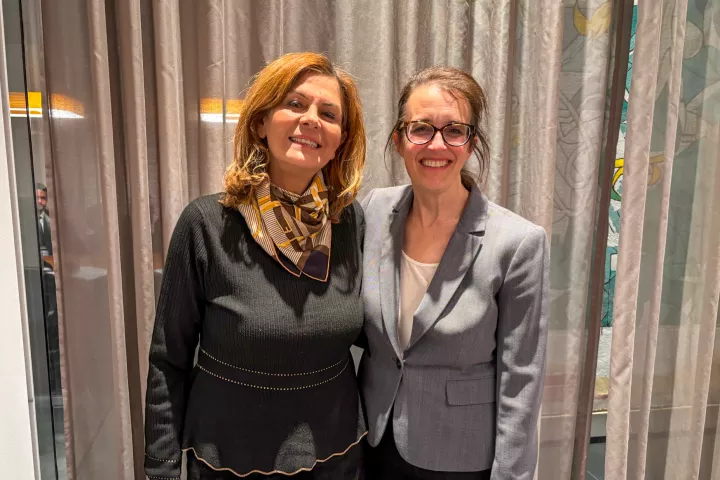
After returning to campus, Gallagher and Drezner joined fellow faculty to provide commentary on their insights from the conference and the state of the Atlantic alliance.
Read and watch analysis from Fletcher faculty below.
Trust Lost
By Kelly Sims Gallagher, Dean and Professor of Energy & Environmental Policy
Trust takes years to build, seconds to break, and forever to repair. This famous proverb best illustrates the most important consequence of the one-two punch delivered by President Donald Trump in Davos and Secretary of State Marco Rubio in Munich. The two speeches visibly moved American allies, particularly in Europe, from a state of shock and denial to one of mistrust.
Much ink has been spilled on Greenland and the question of whether President Trump would go so far as to invade a NATO ally. But quieter questions were also raised in Munich. In Rubio’s speech he insinuated that Europeans were imposing clean energy policies on themselves “to appease a climate cult” while “competitors” are exploiting fossil fuels “not just to power their economies but to use as leverage against our own.” It seems not to have occurred to Secretary Rubio that Europeans are now worried that the United States will use its oil and gas dominance as leverage against them.
In Munich, Europeans openly wondered whether they could count on the United States to honor its natural gas contracts and whether Europe is as vulnerable relying on the United States for gas supply as it was on Russia prior Putin’s initial supply cuts in 2022. At that time, Europe swiftly shifted to diversify sources of gas supply and as of 2026, the United States now accounts for a quarter of Europe’s natural gas imports and 60% of Europe’s LNG supply. Does anyone believe that President Trump would restrain himself from banning natural gas exports to Europe if he wanted to impose serious pressure on the Europeans?
Once trust is lost, it’s difficult to regain. Most likely, Europe will continue its steady transition to renewables, which helps it avoid depending on either Russia or the United States for natural gas. It may go a step further by refusing to sign any additional gas contracts with U.S. producers, which would undermine President Trump’s determination to revive the U.S. oil and gas industry.
Civilization Reduced

By Daniel Drezner, Academic Dean and Distinguished Professor
Distilled to its essence, Marco Rubio’s speech offered the exact same message that Vice President JD Vance delivered in Munich last year: Europe must embrace the definition of Western civilization that Trump and his coterie promote, or get out of the way. Most Europeans were unpersuaded by the friendlier tone—including some of Trump’s friendlier counterparts in the region, such as Finnish President Alexander Stubb.
This definition, as expressed by Rubio, is a cruder reduction of “civilization” than even Samuel Huntington’s version. It is grounded exclusively in Christianity and ethnic heritage, eliding discussion of the classical liberal tradition and civic nationalism that provide western society its key comparative advantages. Asserting the superiority of a civilization while denying the very elements that make it dynamic is the logical contradiction at the heart of Rubio’s speech.
In the end, however, one could probably disregard Rubio’s speech entirely. I say this in light of a mantra I heard repeatedly in Munich: in 2026, actions speak louder than words. Nothing that Rubio said erases the dovish U.S. posture towards Russia, Trump’s appetite to colonize Greenland, or various U.S. efforts to weaponize European dependence. More telling than Rubio’s speech was his decision to skip a key meeting with European leaders to discuss Ukraine, canceling at the last minute. Europeans continue to call for “de-risking” from the United States.
In other words, not much has changed because of Rubio’s speech—and that’s my fundamental conclusion.
An Alliance in Flux

By Chris Miller, Professor of International History
The 2026 Munich Security Conference demonstrated a transatlantic relationship in a state of flux. Both Europe and the US reject the status quo; both agree that Europe should become more capable of defending itself; both disagree on much else. On one side, the Trump administration views the traditional European model of multilateralism and multiculturalism not as a strategic asset, but as an institutional drag that prioritizes process over power. From the Trump Administration's perspective, a decade of prior efforts to politely ask Europe to spend more on defense failed to actually increase European spending. Only shocking steps, they believe, will push the Europeans to invest in their defense.
European leaders, meanwhile, lament the changes that the Trump administration is welcoming and even accelerating. The Trump administration’s outreach to European far right parties is seen as a threat to Europe’s political consensus. Its moves on Greenland have intensified mistrust.
Yet, for all the talk of "strategic autonomy," the conference confirmed a cold reality: Europe’s security depends on American military power. America’s nuclear, space, and other capabilities will be difficult for Europe to replicate, at least in the short run. So long as Russia is at war with Ukraine, Europeans still need U.S. military support.
Good Cop, Bad Cop

When JD Vance spoke at the Munich Security Conference a year ago, everyone was shocked by the language and approach he adopted regarding transatlantic relations. The accusation that Europe has lost its identity and is acting contrary to its core values was the central theme of his speech.
This year, Marco Rubio took a different approach. In stark contrast to other speeches by U.S. officials, including the President himself, Europe was not presented as an unreliable partner that lacks self-confidence and undermines political freedom, national identities, and sovereignty. It was treated in a balanced way: as a traditional ally with a shared heritage, which nevertheless needs to do more in various areas, such as defense, security, migration, and energy.
The apparent differences between the two speeches may represent different policy approaches within the Republican Party regarding Europe. This calls into question whether the prospect of a “shared destiny” of transatlantic cooperation, as suggested by Rubio, is truly viable.
From the US side, however, this ambiguity can prove effective. It is reminiscent of the old "good cop-bad cop" method: an aggressive—almost hostile—tone followed by a more friendly approach, with the aim of obtaining compliance from the other side.
The response of European actors indicates that they got the message. In a press conference after Rubio’s speech, French Foreign Minister Jean-Noël Barrot remarked, “what we're hearing today, we heard already in the past… build a strong and independent Europe. We will deliver a strong and independent Europe.”
For more, read Professor Skiadas's piece in Capital
