

Interdisciplinary, international, and multisectoral—the Fletcher difference.


At Fletcher, we provide a uniquely interdisciplinary, international, and multi-sectoral education.
Student coursework spans global affairs, business, and law. Professors teach and research with a wide array of global perspectives. Fletcher alumni work across the public, private, and civil sectors.
Together, these elements provide students with a distinctive and unparalleled educational experience to prepare them for a meaningful career.
Designed for Complex Careers
“Whenever we take a strategic problem, an international problem, a global problem, it very rarely follows country boundaries, and it very rarely sits narrowly as a political issue, or an economic issue, or a security issue.”
~Professor Abi Linnington
To better understand Fletcher’s particular offerings, we spoke with Professor Abi Linnington, Associate Dean of Curriculum and the Robert L. Pfaltzgraff Professor of International Security. Linnington retired at the rank of Colonel after serving for 25 years in the U.S. Army as a military strategist and aviator.
From 2016 to 2018, Linnington was a special assistant to the chairman of the Joint Chiefs of Staff and served as the director of the Chairman's Action Group. She also received her Master of Arts in Law and Diplomacy and PhD in International Relations from Fletcher–experiences she draws on to help ground her classes in the realities of our modern workforce.
What is Interdisciplinary Coursework?
Developing solutions to today’s global challenges requires novel thinking using multiple lenses.
Our world’s most intractable issues cross borders, industries, and sectors of work. To effectively address these challenges, emerging practitioners need to train across disciplines to see multiple facets of each problem, to understand the history behind current conditions, and to challenge siloed and conventional wisdom.
At Fletcher, we ensure students gain breadth and depth in international affairs through coursework requirements to best prepare them for careers in international affairs, business, law, and more.
Breadth Requirements
All students take courses across Fletcher’s three academic divisions: International Law and Organizations (ILO), Diplomacy, History and Politics (DHP), and Economics and International Business (EIB).
Regardless of students’ post-graduation plans, taking diverse courses like International Humanitarian Law (ILO), Artificial Intelligence: Algorithms, Ethics, and Policy (DHP), and Strategic Management (EIB), will give graduates the knowledge and skills to be more attractive candidates for jobs and be better problem-solvers on the job. To see more courses from the three divisions, take a look at our Courses and Academic Divisions registrar page.
Depth Requirement
In addition to learning across divisions, students in the majority of our degrees gain subject-matter depth by selecting one or two of our ten fields of study.
A student interested in security and conflict could study the subject from the perspective of international organizations or formal and informal diplomacy through the Conflict Resolution field, with the bottom-up examination of individual and community peace and security through the Human Security field, or through the lens of nation-states, non-state armed groups, and technology in the International Security field.
If students are more interested in social entrepreneurship, they may want to pair the practicalities of finance, accounting, and management in the International Business field with the goals of mitigating climate crises in the Environmental Sustainability field.
Professor Linnington notes the value of well-rounded co-workers from her own experience.
"I don't just want to work with people who have similar backgrounds in my field. If you're doing your job well in government, you build and work with interagency teams that look at problems from a variety of interdisciplinary approaches within and beyond your organization.
As a potential hire, you become a more attractive candidate if you can demonstrate that you can analyze a problem from multiple perspectives, frameworks, or fields of study and bring that functional expertise to an organization."
An International Perspective

Fletcher is one of the few American APSIA schools with roughly 50% international students. As a result, courses focus on international policy problems and integrate diverse perspectives that help students prepare for global careers.
“Our students hold faculty accountable, and we hold ourselves accountable to a curriculum that is not geared strictly to how the U.S. government works. But also, how does the UN work? How does the African Union work? How does NATO work? And how do allies, partners, and adversaries make decisions? When have nation-states and international organizations been more or less effective in the development and implementation of policies to solve shared public policy issues? Because most of the issues that we're bringing to the international table are not one-nation issues,” notes Linnington.
With multi-national challenges like decarbonization, preventing and mitigating conflicts, and scarcity in the international economy, we need coalitions of the willing, not limited perspectives.
Fletcher students bring diverse and unique perspectives from around the world that enrich discussions and coursework.
"A big part of what I took from Fletcher was the network of students. It has such a rich student body. I can remember sitting in conflict resolution courses with a student who was from the government of the People's Republic of China and somebody from Tibet, who is now a member of the Tibetan parliament in exile. Who gets to do that in a graduate school-level class and have open, honest conversations?"
~ Kara C. McDonald, F98, U.S. Ambassador to the Republic of Lithuania
Multi-Sectoral Expertise: Working Across the Public, Private, and Civil Sectors
Most of our alumni change sectors over the course of their careers. Perhaps starting in the foreign service before transitioning into the corporate space, or working in the field at an operational NGO before deciding to make the switch to a local or federal government role.
To not only function but thrive in these diverse environments, we train students to build functional expertise across perspectives in these sectors.
Exploring Perspectives: A Strategic Exercise
When hiring Presidential Management Fellows to work for the Chairman of the Joint Chiefs, Linnington used a strategic problem-solving writing exercise that she now assigns to Fletcher students to help build their writing skills and apply their country, regional, or functional area expertise.
Individuals put themselves in the shoes of the advisor to the Minister of Defense, the Minister of Foreign Affairs, or a corporate CEO. Over the course of a semester, students select and analyze the root causes of a specific strategic problem and devise a novel solution for addressing it. Eight of Linnington’s students have gone on to publish their resulting white papers.
During Linnington’s time in the military, she hired individuals into the Chairman’s think tank based on the quality of their writing and analysis.
“I hand you a tough assignment to accomplish within 24 hours and a series of interviews with me and the team. How well you write determines whether I hire you for the job and give you a seat at the table with the chairman of the Joint Chiefs over the next few months. For example, I hired a recent Master’s graduate with six months of experience working for the Counter-ISIS task force. She drafted several white papers for the Chairman analyzing ISIS and conflict in Iraq and Syria within 2-3 months of being on the job, and she informed the chairman’s engagements and meetings during a trip to Iraq later the same year. That is a tremendous win and experience for a junior civil servant.
I’ve adapted this experience to a series of in-class exercises that put you in the shoes of the decision makers – the Minister or Ambassador – that you aspire to be in the future. The exercise encourages you to apply what you’ve learned across fields to create a strategy that blends diplomacy, economics, and security tools into a comprehensive approach. Students learn that if they advocate for a military approach or the use of force, they must analyze the political and economic impacts as well."
A Notable Example: China and the NBA
One memorable paper for Linnington dealt with a confrontation between the National Basketball Association (NBA) and the People’s Republic of China. In 2019, the NBA and the People’s Republic of China clashed over an NBA general manager’s tweet in support of the Hong Kong protestors.
With significant financial, economic, political, and reputation risks at stake for the NBA, the student wrote from the perspective of an advisor to the NBA CEO, providing three different approaches for them to navigate a difficult situation and highlighting their distinct opportunities as well as the potential consequences of action or inaction.
The student explored the multi-billion dollar economic ramifications of alienating a massive and growing market in China, the high reputational risks of disavowing the tweet for an American sports-based organization, and the impact on U.S-China diplomatic and economic relations.
There was no one right answer for this challenge; the NBA CEO needed to review options from every angle and multiple disciplines, and it gave the student an opportunity to grapple with a fascinating problem during his time in Linnington’s class.
Gaining Real World Experience
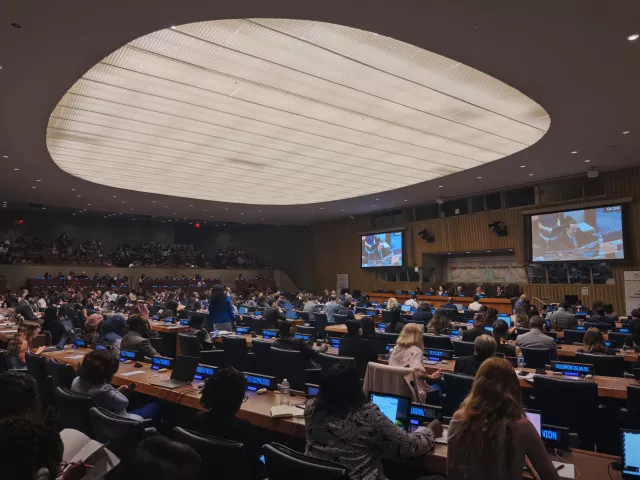
Through in-house simulations, external competitions, internships, and client work, Fletcher students can increasingly test their interdisciplinary, international, and multi-sectoral learning in the real world.
Simulations like our Red Team exercise, or Peace Games, give students a chance to explore strategic issues in relatively low-stakes environments while collaboratively learning through the process.
As they work through their degree, many turn to external competitions, internships, and client work to stress-test their capacity and build their networks.
Competitions like the Raisina Dialogue, Fletcher D-Prize, and Army War College simulation see Fletcher students collaborating with and competing against students from institutions like MIT, West Point, Harvard, and more.
Other classes bring in public sector, non-profit, or private sector clients that need help with specific challenges across the business, NGO, and public space. And many students take up summer internships to continue to build real-world expertise. See more examples of students’ experiential learning in this recent article.
Navigating the AI Job Market
Practical application of skills during students’ time at Fletcher helps cultivate expertise and confidence, but the real test for many students is finding a meaningful job after graduating, particularly in the rapidly changing AI-driven job market.
Through building interdisciplinary, international, and multi-sectoral expertise, Linnington notes that students learn hard skills that will serve them for life.
“Critical analysis, research, and writing are essential aspects of learning in all of our fields of study. The magic happens when you learn how to craft analyses and solutions that bridge the gaps between fields and ultimately how you create new solutions.”
While AI can make some analytical tasks easier, Linnington highlights that interdisciplinary analysis and critical thinking are not easily replaced and are essential to professional success across sectors and industries.
What Does Mastery of These Skills Look Like?
Through their time at Fletcher, students cultivate this essential expertise and these talents.
- Critical analysis: identifying the main arguments and structure of an argument; evaluating evidence, identifying biases, and evaluating opposing views; constructing an argument, supporting with evidence, and illuminating logical connections; interpreting data.
- Research: gathering, synthesizing information, judging credibility of sources and data
- Writing: cultivating excellent research skills as well as cogent, short-form analytical writing, like white papers
- Geographic knowledge: building expertise in a specific country, region, or transnational phenomena.
- Functional expertise: expertise within a specific field of study, such as humanitarian assistance, conflict analysis, security cooperation, etc.
- Problem-solving: identifying root causes and designing solutions that are realistic or feasible, politically acceptable, and suitable for addressing the problem.
- Feedback loops: identifying alternative viewpoints, implementing and testing ideas, and adjusting as they go.
What’s Next?
Wherever prospective students are in their graduate school journey—starting to explore options, comparing degrees, or contemplating future career paths—Fletcher offers a distinctive value proposition. Its interdisciplinary education model, international perspectives, and multi-sector engagement prepare students for dynamic and meaningful careers.
Fletcher professors and peers help students learn critical adaptability, resilience, and a fundamental understanding of what real problems and solutions look like across the public, private, and civil sectors. Through this experience, students gain the perspective and skills needed to lead innovative solutions.
The world’s most pressing challenges do not fit neatly within a single discipline, sector, or border—and education should not either.
Learn more about our degrees and opportunities for student learning.