

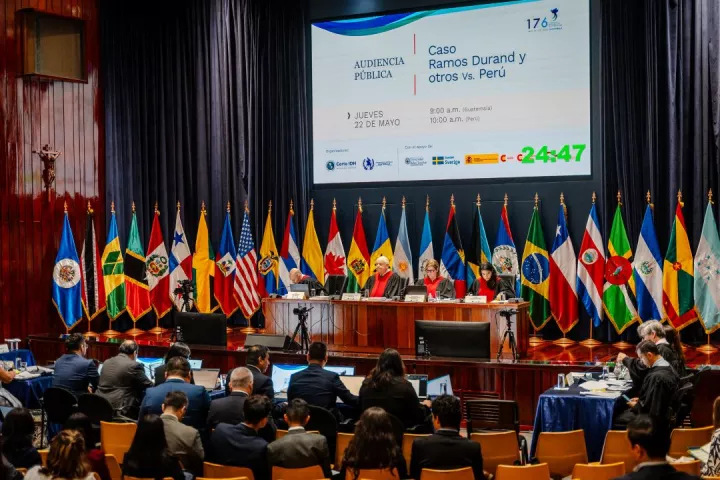
Kimberly Theidon testifies before Inter-American Court of Human Rights


In 1997, Celia Ramos, a 34-year-old mother of three, died during a forcible sterilization surgery at a local medical outpost in rural Peru. She was one of more than 300,000 women forcibly sterilized during the 1990s under the regime of Alberto Fujimori.
Forced sterilizations were part of Fujimori’s official state policy, primarily impacting low-income Indigenous women who lived in rural communities. Celia Ramos, like many of these women, was sterilized under coercion. She also was stripped of her right to life after an allergic reaction during her surgery rendered the mother of three dead.
Ramos’s case was tried in the highest human rights court in Latin America. In a landmark ruling on March 6, the Inter-American Court of Human Rights determined that Peru was responsible for Ramos’s death.
The ruling is an important step in justice not only for Celia Ramos’s family, but also for the thousands of other women whose rights were violated by the Peruvian government. The ruling also has ripple effects around the world as other nations continue to seek laws that value sexual and reproductive rights.
Fletcher Professor Kimberly Theidon, who studies gender and medical anthropology, provided expert testimony before the court and was a significant voice in the ruling.
From Research to Court
Theidon spent many years in Ayacucho, the highlands of Peru, where she observed civilians hit hardest by Peru’s armed conflict. In conjunction with Ayacucho’s office for the Truth Commission, Theidon investigated the depths of gender-based and sexual violence in the region. Her expertise led her to give both written and oral testimony in Ramos’s case.
“When I look at who was the target of state violence and who was the target of forced sterilizations—300,000 women sterilized from 1996 to 2001—the Venn diagram maps almost perfectly into one circle,” Theidon said.
“We now have an increased awareness of reproductive violence,” she added. “With regards to obstetric violence, we are trying to get a more nuanced understanding of the forms of harm that occur to people of different genders, so that we can advocate for more effective reparations and psychological support for victims.”
Theidon’s field work has scalar implications, moving from the intimacies of her research subjects to the larger structural forces at play at the time.
At the beginning of her time in the field, Theidon studied the rhetoric of gender stereotypes and ethnic discrimination as part of the colonial legacy in Peru and other Latin American countries. As she began to understand the stakes around her, her research evolved to investigate and document the horrors of Peru’s enforced sterilization program that included a coercive quota system that led healthcare providers to violate free and full informed consent.
“During Fujimori’s second regime, he had this discourse of the war on poverty and saving the country from terrorism,” she said. “Part of the war on poverty ended up being a war on the poor. There are various ways to go about solving poverty. One would be to figure out redistributive policies. Another is to decide you have too many of the poor. We saw the deployment of that rhetoric in Peru’s highly authoritarian context.”
Gender and Human Security in International Affairs
Reproductive warfare continues to wreak havoc on communities all over the world. Theidon’s work at The Fletcher School encourages students to look at cycles of violence and seek justice at every level, in every sector.
Theidon teaches in Fletcher’s Human Security field of study. The field’s interdisciplinary curriculum allows students to examine international affairs at the intersection of human rights, conflict analysis, and humanitarian studies. When it comes to justice—especially regarding gender and sexuality—Theidon’s work in the field and the classroom shows just how profoundly important it is that these practices remain in dialogue with one another and with the legal system.
Justice for Celia Ramos
Celia Ramos’s family had been seeking justice since 1997. Ramos lived in a small town where officials from the health clinic repeatedly visited her home, telling her to report to the clinic. She wasn’t interested, but in the face of their unrelenting persistence, she finally agreed.
“And so there she was in 1997 in a makeshift operating room,” Theidon said. “These were not hospitals. These were not sound healthcare centers. Frequently, they were improvised. They had military cots. Sometimes they had soldiers at the door so the women couldn't get away.”
In the court documents, photographs show military personnel mixed in with officials from the Ministry of Health.
“When she started to go into shock, they barely had running water, and she died,” Theidon said.
The court case brought many elements of this unjust regime to light. Theidon and others who testified shared first-person accounts, images, and reports of imposed quotas as recounted by health professionals.
Theidon’s work in gender analysis and human security illuminates how and why the well-being of others must be always central to international affairs work in every field.
“One of the best days in my life was giving testimony,” she said. “With everything I've studied, written, and prepared for, this was one of my outstanding debts with Peru, and I was so grateful I could play some role in obtaining justice for people.”
“This is huge, not just for Celia Ramos,” she added. “In an order from the court, the Peruvian government is mandated to pay economic and symbolic reparations to her family and to establish guarantees of non-repetition to ensure nothing like this ever happens again. This ruling establishes a precedent for the thousands of women who were forcibly sterilized and has repercussions throughout the Americas. The Peruvian state has been found guilty of reproductive violence and obstetric violence as a form of institutionalized gender discrimination.”
Read more of Kimberly Theidon’s research in her book, Legacies of War: Violence, Ecologies, and Kin (Duke University Press), and her chapter, “Reproductive Warfare: Enforced Sterilizations in Peru,” in Citizenship on the Edge: Sex/Gender/Race (University of Pennsylvania Press).