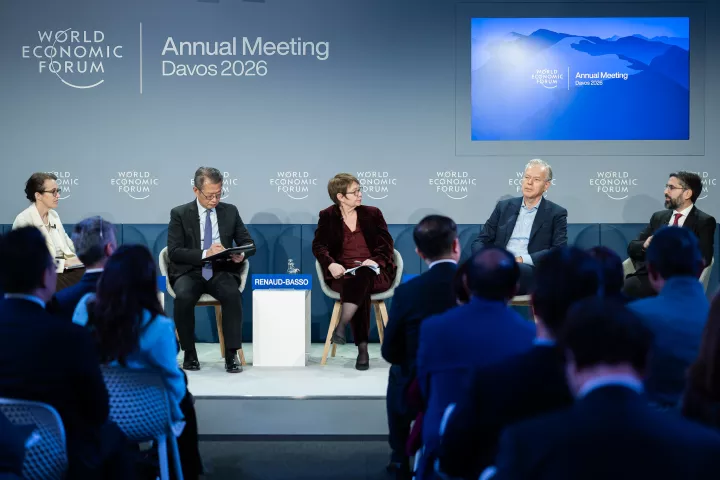
Kelly Sims Gallagher and Chris Miller speak at World Economic Forum


Last month, Dean of The Fletcher School Kelly Sims Gallagher traveled to Switzerland to participate in The World Economic Forum’s Annual Meeting in Davos. Global leaders in government, business, and civil society gather in Davos every year to set priorities in addressing key world issues.
Conversations this year revolved around artificial intelligence (AI), geopolitics, and tension between President Donald Trump and Canadian Prime Minister Mark Carney.
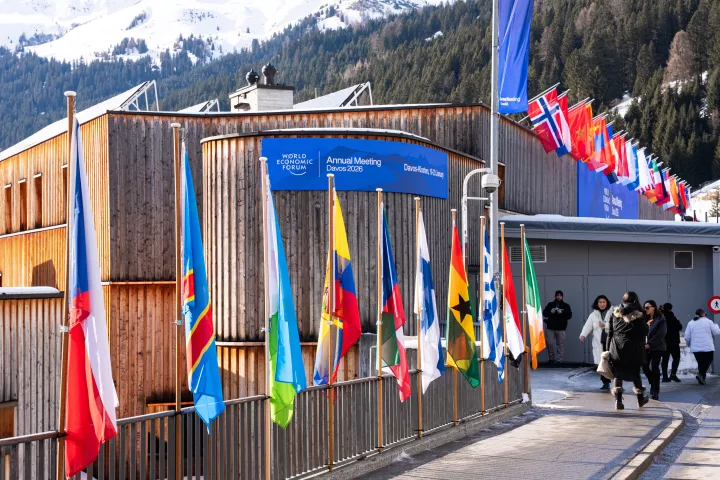
Gallagher traveled to the summit where she participated in six events, including official program panels that investigated climate finance and the potential for a global plastics treaty. Chris Miller, professor of international history, also spoke in a session dedicated to his book, Chip War: The Fight for the World’s Most Critical Technology.
The Chip Effect
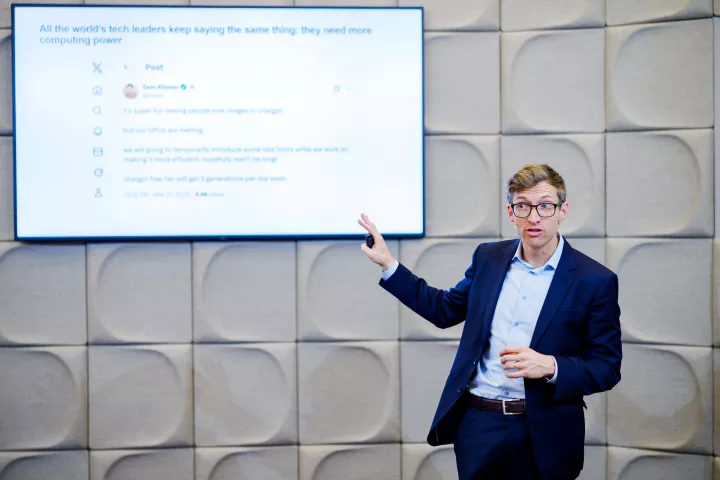
Miller joined Cerebras CEO Andrew Feldman for a conversation on how innovation can be deployed at scale and responsibly in the semiconductor sector. The discussion examined how chips have become one of the world’s most important strategic resources, influencing technology development, trade, and global power.
The session drew on the themes of Miller’s New York Times bestselling book, which won the Arthur Ross Book Award and was named a book of the year by Foreign Affairs, The Economist, and the Financial Times. Miller explored how advances in artificial intelligence, climate pressures, and demographic change are reshaping the semiconductor industry and the policy choices that will determine its future.
Watch the full event here:
Will We Ever Have a Global Plastics Treaty?
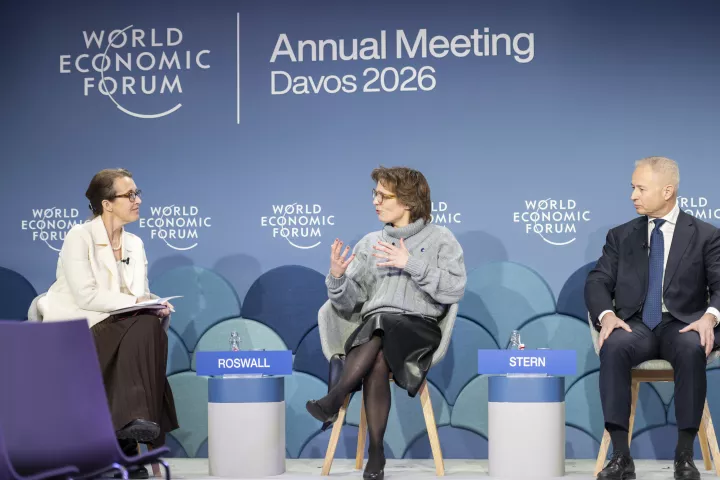
Gallagher moderated a panel on the possibility for a plastics treaty with Jessika Roswall, environment commissioner for the European Commission, José Manuel Ramos-Horta, president of Timor-Leste, Alfred Stern, CEO of energy company OMV, and Frank Tang Kui, CEO of FountainVest Partners.
“In August 2025, negotiations for a global plastics treaty stalled once again, leaving the world without a clear path forward,” Gallagher said in her remarks. “Meanwhile, plastic pollution continues to pose growing challenges for climate, health, and economies around the world.”
Enacting a plastics treaty, she added “is, first, necessary. We need to have it. It must be complemented by national regulation. There’s more that needs to be done at the national level. And we need to create aligned incentives for both producers and consumers.”
Watch the full panel discussion here:
How to Finance Decarbonization
Gallagher also moderated a panel on climate finance, exploring roads to decarbonization. Joining her were Conrad Keijzer, president and CEO of Clariant, Odile Francoise Rrenaud-Basso, president of the European Bank for Reconstruction and Development, Rovshan Najaf, president of SOCAR (State Oil Company of the Azerbaijan Republic), Azerbaijan, and Paul Chan Mo-po, financial secretary of Hong Kong.
The session examined the transition to a more sustainable economy, which Gallagher noted will require unprecedented levels of public and private finance at a time of slowing growth, high debt, and uneven political support.
“We cannot solve this problem on public finance alone,” Gallagher said. “There just isn’t enough public finance alone to be able to address this very complex global issue of climate change.”
“One issue that has continued to bedevil the negotiations and our progress more generally is access to finance,” she added. “That is not only a problem in developing countries and emerging economies, but even in advanced industrialized economies, finding the right levels of finance is important to be able to mobilize the capital that’s needed.”
Watch the full panel discussion here: