

Coast Guard Veteran Chris Salinas turns to the Global Master of Arts Program


Chris Salinas, F26, graduated from the Coast Guard Academy in 2010 with a degree in international affairs, entering service during a turbulent global moment marked by economic instability and ongoing conflict. Like many Coast Guard officers, his early assignment was at sea, conducting search and rescue and counternarcotics operations aboard a cutter in the Caribbean.
“At the time, it felt like the typical path: get on a big white boat down south and go do the job,” he said.
That initial experience quickly expanded beyond the expected. After his first tour, he participated in an international counternarcotics exchange in Cartagena, Colombia—his first exposure to working closely with foreign partners. He then spent three years with the Coast Guard’s International Training Team, leading deployments around the world to train developing maritime security forces. Over that period, he completed 16 deployments to 12 countries, working at the intersection of operational execution and international engagement, including missions in Liberia during the 2014 Ebola outbreak. Those assignments came with a level of responsibility that often felt disproportionate to his rank.
“I was often a very junior officer carrying a lot of responsibility,” he said. “In some cases, I was the senior-most Coast Guard representative in the region.”
In one memorable instance, he inadvertently gave a speech to the President of the Marshall Islands, unaware he was in the room—an experience that underscored the scope of responsibility he carried early in his career.
The international dimension of his military service left the strongest impression.
“You’re building relationships and figuring out how to work across different systems, cultures, and languages, trying to make something actually function in the real world,” he said.
Career Development After Military Service
After leaving active duty, he used the GI Bill to pursue a master in business administration, seeking to translate his military experience into the private sector.
“The MBA gave me a framework for understanding how organizations operate outside the military,” he said. “It helped bridge the gap and gave me credibility in the corporate world.”
Since 2019, he has worked at IBM, where his focus has increasingly shifted toward the role of technology in global affairs and how emerging technologies are shaping both opportunity and risk on a global scale. Watching the rapid evolution of unmanned systems in Ukraine brought that realization into sharper focus.
“It became clear that the nature of conflict was changing quickly,” he said. “I felt a strong pull to re-engage in a more meaningful way.”
A Mid-Career International Affairs Degree
Encouraged by a Coast Guard mentor, he began exploring mid-career academic programs and ultimately chose Fletcher’s Global Master of Arts Program (GMAP).
“I was looking around, and if I'm being honest, I barely considered other options,” he said. “The GMAP offered the academic rigor I wanted and the flexibility to continue working.”
At Fletcher, Salinas wanted to focus on the role of autonomous systems in maritime environments, particularly in remote and challenging regions. Early in the program, he took a chance on an opportunity to attend the Arctic Circle Assembly in Reykjavik.
“I booked a flight, packed light, got myself a tiny room in a hostel, and went to Iceland for four days,” he said. “It was a chance to learn first-hand about a region that I had no experience with and to understand the global scale of the challenges there.”
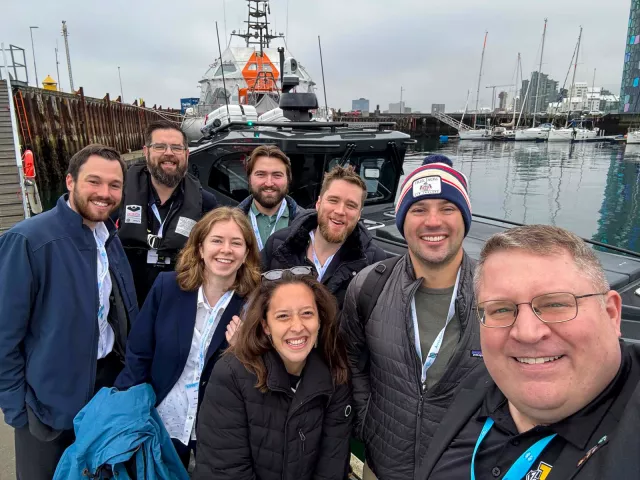
That experience helped shape the direction of his research. He began exploring how maritime safety and communication operate in the Alaskan Arctic, asking practical questions rooted in his Coast Guard background. How have global events shaped Arctic activities? How difficult is search and rescue in such a vast and remote environment? What gaps exist in communication and coordination? As his work developed, he engaged with experts across disciplines, many of whom were willing to connect because of his affiliation with Fletcher.
His project ultimately took shape during the program’s Paris immersion, where collaboration with classmates from diverse professional backgrounds helped refine both his ideas and his approach.
“The cohort itself has been one of the most valuable parts of the experience,” Salinas said. “Being surrounded by classmates from across the world—each with their own perspectives and expertise—pushes you to approach problems in ways you wouldn’t on your own.”
Bringing Learning Beyond the Classroom
Through GMAP, Salinas has found both intellectual challenge and a renewed sense of purpose.
“You learn how these global systems are supposed to work,” he said. “At the same time, you’re watching them come under stress in real time. It forces you to think about what holds them together and what happens when those structures start to break down.”
Across his career from the Coast Guard to the private sector and now Fletcher, the throughline has been a commitment to mission-driven work.
“One of the hardest parts of leaving the military is missing that sense of purpose,” he said. “You want to feel like what you’re doing matters in a broader context.”
That perspective continues to shape how he approaches his work today. He hopes to take his research beyond the classroom and into practice, contributing to policies that improve safety and coordination in complex environments. The motivation, he said, is the same one that drew him to service in the first place: a belief in doing something that matters.
“You join the military because you believe in doing something with a mission,” he said. Confronted with global instability, he sees that that instinct remains difficult to ignore. “It’s hard not to want to pick up a proverbial rifle and go try to fight the fight again.”
For him, time at Fletcher has been a way to channel that instinct more deliberately—an opportunity to step back, invest in himself, and prepare for whatever that next “fight” may look like.
Read more about Fletcher’s Global Master of Arts Program.